Neville Tuli-Curated SWARAJ Revisits India’s Journey Towards Political Self-Rule and Self-Discovery

A nation does not remember its history through dates alone.
It remembers through images that captured defining moments, words that shaped public thought, songs and slogans that stirred generations, photographs that preserved the faces of an era, paintings born from resistance, newspapers that reflected the mood of a nation, and everyday objects that quietly became witnesses to extraordinary times.
It is this expansive and living memory of India that forms the heart of SWARAJ: Revisualising India’s Political History, presented by The Tuli Research Centre for India Studies (T.R.I.S.) and curated by its founder, Neville Tuli.
The exhibition opens at the Visual Arts Gallery, India Habitat Centre, New Delhi, on August 12, 2026, bringing together rare artworks, photographs, books, prints, film publicity art, memorabilia, and visual, textual and audio archives to trace India’s long and complex journey towards political self-rule and self-discovery.
Yet SWARAJ is not history viewed from a distance. It invites audiences to step into it.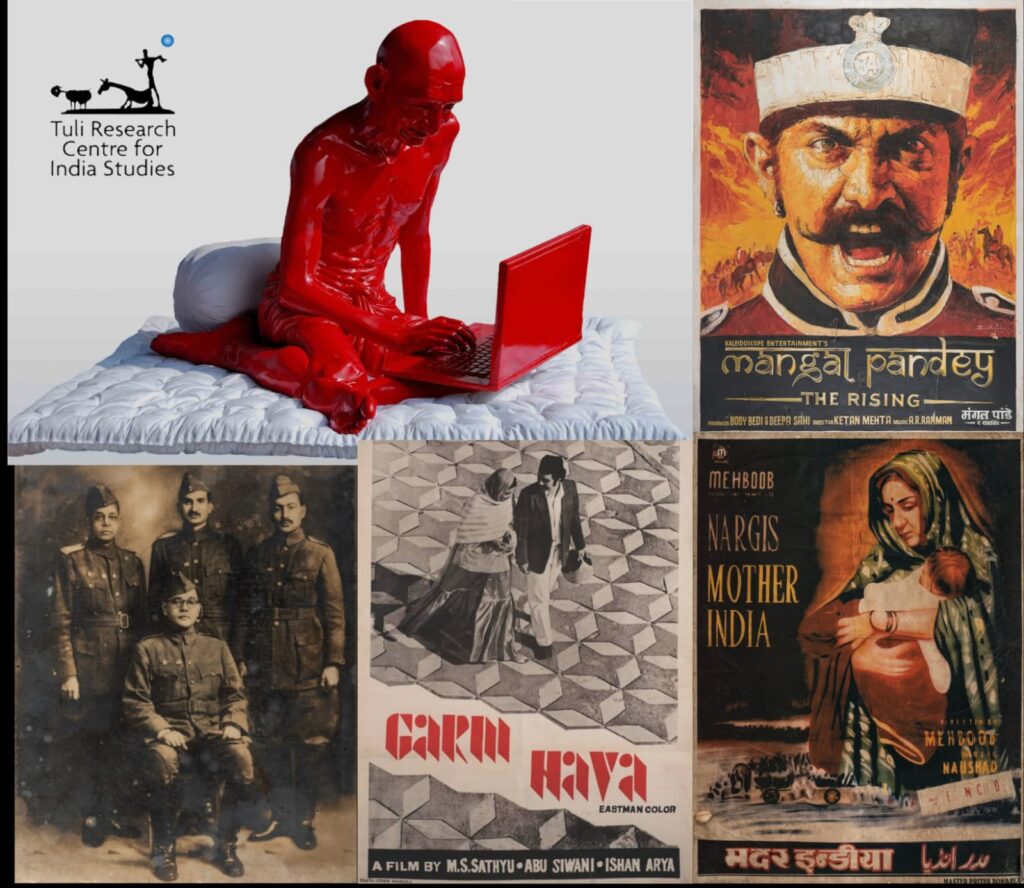
The exhibition encourages visitors to reconsider where India came from, the struggles that shaped its political consciousness, the forces that divided and united its people, and the ideas of freedom, identity and democracy that continue to influence the country today.
At its core is a simple but powerful proposition: history is not merely information about the past; it remains a living force that shapes the present and influences the future.
The journey begins with early European coastal views of India and the intellectual awakening of the Bengal Renaissance before moving towards the First War of Independence in 1857. From there, the exhibition follows the emergence of Indian printing presses, political propaganda and photojournalism, alongside the growing influence of cinema and visual culture.
Symbols that came to define India’s political imagination — Bharat Mata, Mother India and the evolving Tiranga — occupy an important place in this visual journey. So does Mahatma Gandhi, presented not only as a political leader but also as a powerful image and idea that helped mobilise millions.
The exhibition brings together the stories and representations of personalities who became central to India’s political and intellectual awakening, including Swami Vivekananda, Dadabhai Naoroji, the Tagore family, Bal Gangadhar Tilak, Rash Behari Bose, Annie Besant, C. Rajagopalachari, Jawaharlal Nehru and Netaji Subhas Chandra Bose, among many others.
But SWARAJ does not present India’s political history as a simple story of triumph.
It also confronts some of the country’s most difficult and contested chapters — Partition, the framing of the Constitution, the integration of princely states, the Emergency, wars, communal tensions, protests and people’s movements that repeatedly challenged established power and altered the nation’s course.
For Neville Tuli, understanding political history also requires looking beyond the boundaries of conventional historical narratives and examining the many forms through which a society recorded and remembered itself.
The media emerges as a crucial witness.
Newspapers, journals and magazines are presented alongside photographs by Felice Beato from 1858, images by Henri Cartier-Bresson from the final days of Mahatma Gandhi’s life, and photographs by Reuters photojournalists documenting violence, protests and political upheaval across India during the 1980s and 1990s.
Art becomes another form of testimony.
Works associated with artists including Chittaprosad, Gobardhan Ash, Ramkinkar Baij, Qamarul Hassan, Somnath Khosa, Altaf, Prokash Karmakar, Vivan Sundaram and Sudhir Patwardhan reflect the anxieties, injustices, aspirations and transformations experienced by Indian society across different periods.
Some of the most compelling historical traces are found in objects that might otherwise appear ordinary.
Among the exhibits are matchbox tin covers carrying misprinted names of Swadeshi leaders from around 1921, Ramendranath Chakravorty’s Gandhiji at Dandi, Chittaprosad’s 1942 Quit India, photographs from the Madan Mahatta Archives, and Gigi Scaria’s Who Deviated First? These works and objects demonstrate how political memory can survive not only in monuments and official records, but also in everyday visual culture.
Perhaps the exhibition’s most contemporary conversation, however, is with India’s young generation.
SWARAJ draws connections between the questions, impatience, idealism and desire for change experienced by young Indians today and the aspirations of earlier generations who confronted their own political and social realities.
The faces change.
The circumstances change.
But questions of freedom, identity, justice, democracy and belonging continue to resonate.
In that sense, history suddenly feels much closer.
The exhibition concludes with ‘Gandhiji in Contemporary India’, inviting audiences to reflect on the continuing relevance of Gandhi in a nation still negotiating questions of dissent, democracy, citizenship and its evolving identity.
Ultimately, SWARAJ is not simply an exhibition about looking back.
It is an invitation to look at ourselves.
Because a nation’s history is defined not only by what happened, but also by what it remembers, what it forgets, and what it chooses to carry forward.
Exhibition Details
SWARAJ: Revisualising India’s Political History
Presented by: The Tuli Research Centre for India Studies (T.R.I.S.)
Curated by: Neville Tuli
Preview: Wednesday, August 12, 2026, at 6 PM
Dates: August 12–16, 2026
Timings: 11 AM–7 PM daily
Venue: Visual Arts Gallery, India Habitat Centre, Lodhi Road, New Delhi
Entry: Free and open to all